 Login
Login Store
Store Search
By Alexandre Rocheleau, MHK, Certified Mental Performance Consultant CSPA/AASP
Performance excellence in skiing encompasses many performance areas including technical skills, tactical decision-making, physical preparation, and mental performance. While each of these factors contribute to excellence on snow, this article will focus specifically on the psychological aspect of performance excellence.
A variety of mental skills and tools can facilitate an excellent performance. This initial article of potentially more will focus on activation regulation – The ability to manage activation level to meet the demands of various performance contexts.
How “Activated” Should I Be to Perform with Excellence?
It is a common belief that you must be perfectly calm to perform at your best, but that is usually not the case. Instead, performance is typically optimized when individuals are in a moderately activated state, as opposed to a calm state. This relationship is commonly represented using an inverted-U model of activation and performance (figure 1).
Figure 1
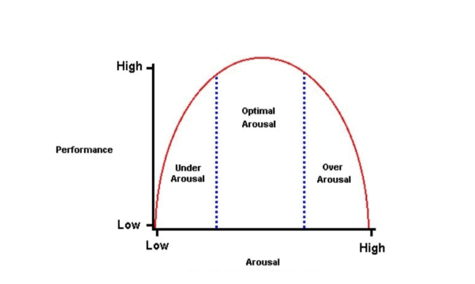
Note: This model is oversimplified – It is important to note that individual traits, skill level, as well as the skiing situation will influence how activated a skier should be to perform optimally. For example, a skier in an all-terrain environment who constantly has to make rapid decisions may perform better with a slightly higher level of activation than a skier demonstrating technical proficiency in short radius turns on more predictable terrain.
Recognizing My CURRENT Activation State
Being able to recognize your own level of activation is the first step towards adapting it to your benefit!
When the level of activation is too low for the task at hand, skiers may experience:
- Reduced physical energy and/or a “heavy” feeling
- Slower reaction time and delayed initiation in movements
- Difficulty maintaining focus on the task
- Lack of clarity in skiing intention
These signs often indicate skiers are not sufficiently activated for the task they are trying to perform. While this state may feel overall comfortable and relaxed, it can hinder performance excellence.
When the level of activation is too high for the task at hand, skiers may experience:
- Excessive muscle tension, feeling of forced movements
- A sense of rushing and/or feeling “sped up”
- Shallow or uncontrolled breathing
- Hyper-focused and/or overthinking state
These signs often indicate skiers are too energized and potentially threatened by the situation to perform optimally. High levels of activation make it difficult to effectively adapt to changing situations and may hinder the automaticity of already-established movement patterns.
When the level of activation is appropriately matched to the demands of the task, skiers may experience:
- A sense of physical readiness without unnecessary tension
- Smooth, efficient, and coordinated execution of movements
- Breathing that feels controlled and naturally aligned with effort
- A flexible focus on the environment.
- Mental engagement without feeling overwhelmed
These signs often indicate that a skier’s activation level is well matched to the situation. In this state, skiers are more likely to process information effectively, promptly adapt to changing terrain, and let automatic movements take the lead whenever possible.
The Skill of Regulating Activation
Recognizing your current activation level is the first step – the real skill is being able to change it to meet the demands of the task. Regulating activation isn’t inherently complicated, but it requires exploration as individuals learn what works best for them. Below are 3 mental skills commonly used to change the level of activation.
1. Breathing techniques
Breathing exercises are one of the most direct ways to influence the level of activation. Slower, more controlled breathing with longer exhales can help reduce activation and create a sense of calm and control. On the other hand, faster breathing can help increase activation to feel more engaged.
| Pro Tip: If you need to down-regulate, try box breathing (4s in, 4s hold, 4s out, 4s empty). If you need to up-regulate, try matching your breathing to the rhythm of your favourite upbeat song. |
2. Self Talk
Self-talk influences skiers’ interpretation of the performance demands and their emotional responses. Using simple and calming self-talk can help reduce mental noise and improve clarity under high activation. On the other hand, using energizing, intent-driven self-talk can help increase focus and precision when the level of activation is low.
| Pro Tip: If you need to down-regulate, use a cue word in your self-talk that helps you feel calm ex. “find your middle”. If you need to up-regulate, use a cue word that helps you feel energized ex. “Go strong, go steady”. |
3. Performance Cue Setting
Performance cue setting involves the identification of one or two cues that are most relevant to the task at hand. These cues can act as attentional anchors and help stabilize the level of activation. When activation is too high, they can help reduce mental overload by filtering out irrelevant information. Conversely, they can help skiers focus on the relevant performance aspects of the task when activation is too low.
| Pro Tip: Ensure the performance cue(s) are simple and specific to your intention ex. Faster acceleration across the hill after the fall line in short turns. |
These skills are not one-size-fits-all. Skiers are encouraged to use them as starting points to experiment and identify what works best for them in different situations.
There is no perfect level of activation – successful skiers are those who learn to recognize their current level of activation and adapt it to what works best for them in different situations. Like any other skiing skill, this ability develops with awareness and practice.
If you have any questions about the article, please feel free to reach out! rocheleau.alexandre.consulting@gmail.com